EU Right to Repair Directive Explained (2026): Your New Right to Fix Phones, Appliances & Electronics
The EU Right to Repair Directive gives consumers stronger repair rights, longer warranty protection, and access to affordable repairs even after the warranty expires.
The Right to Repair Directive, formally Directive (EU) 2024/1799, is the EU's first-ever law that gives you a legal right to get your broken products fixed. The European Parliament and Council passed it on 13 June 2024, it was published in the EU's official journal on 10 July 2024, and it entered into force on 30 July 2024.
But here is the key date for your calendar: 31 July 2026. That is the deadline for every EU country to turn this directive into national law. From that day on, the rules below become enforceable in your country.
The Law Explained:
The law works in two layers:
Layer 1: During your warranty.
The directive changes what happens when something breaks within the first two years. If your washing machine dies in month 18 and the seller offers you a brand-new replacement, you can now say that you want it fixed. If you choose repair, your warranty gets extended by 12 months from the day the repair is finished. So instead of your warranty expiring at month 24, it now runs until month 30 (or longer, depending on when the repair happened). The seller must tell you about this right before they offer you a swap.
Layer 2: After your warranty expires.
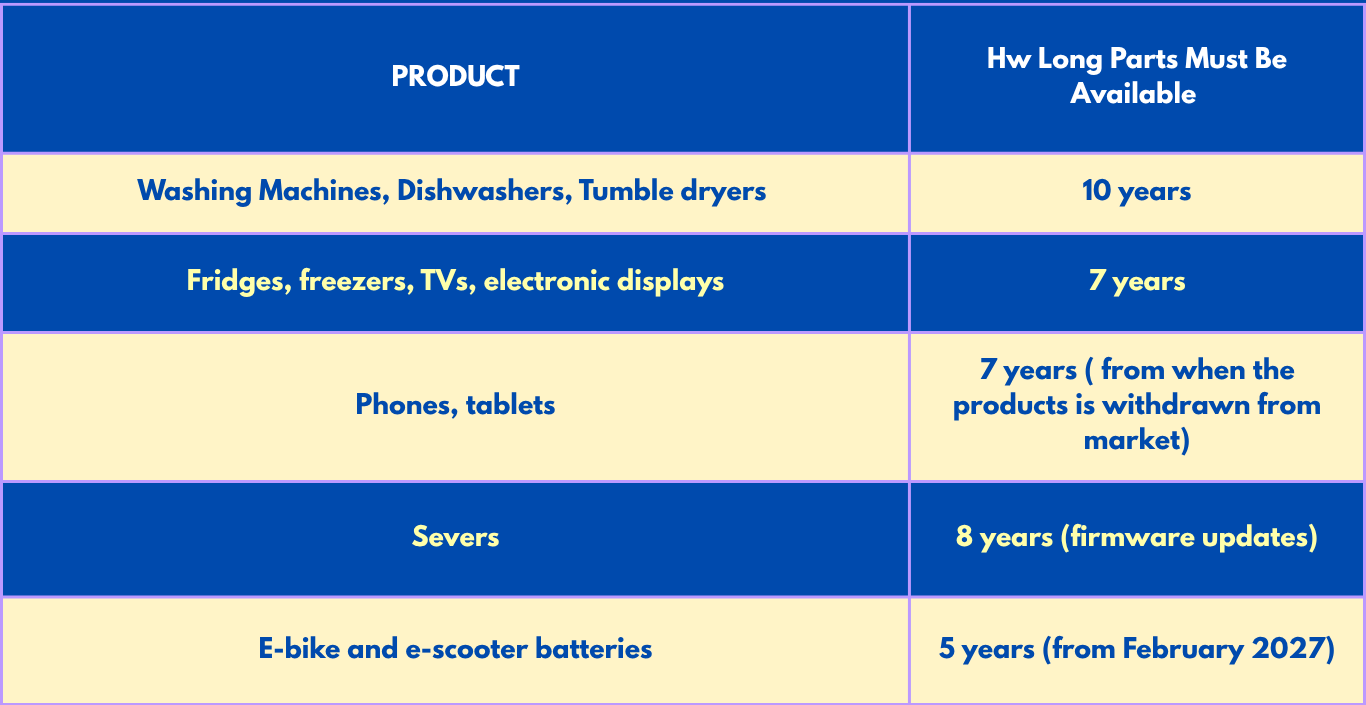
Even after those two years are up, manufacturers of certain products are legally required to repair your item if it breaks, at a fair price and within a reasonable time. This applies to the products listed in the directive's Annex II (see the full list below).
Important nuance: The 12-month warranty extension applies to products you buy on or after 31 July 2026 (though your country can choose to apply it earlier). The post-warranty repair obligation, however, applies to the listed products regardless of when you bought them, so if you bought a fridge in 2024, the manufacturer must still honor repair requests from 31 July 2026 onwards, as long as spare parts are still required to be available.
Why It Was Passed: What Problem Is This Solving?
The Directive was conceived to reverse a throwaway culture with staggering environmental and economic costs. The European Commission identified that 35 million tonnes of waste and 261 million tonnes of greenhouse gas emissions are generated annually in the EU from the premature disposal of repairable goods . This costs consumers nearly €12 billion because they are forced to buy new instead of fixing what they already own.
Three Specific Issues Drove This Law:
1. Products are designed to be unfixable
Manufacturers use glued-in batteries, special screws that standard screwdrivers cannot open, and software that bricks your phone if an independent shop touches it. Spare parts are either unavailable or priced so high that buying new seems cheaper. For example, if your vacuum cleaner's motor fails, but the manufacturer stopped making the replacement part three years ago, you have no choice but to bin a machine that is otherwise fine.
2. Consumers lack information
At the store or on Amazon, you see a new smartphone, but you have no clue whether the battery can be replaced, how long spare parts will be available, or what a screen repair typically costs. The law fixes this by requiring repairability labels and upfront information.
3. Independent repairers are locked out
Even if you wanted to support your local repair café, manufacturers often blocked them with contractual restrictions, refused to sell them spare parts, or denied them the diagnostic software needed to identify the fault. The directive tears down these walls.
A Eurobarometer survey found that 77% of EU citizens would rather repair their electrical appliances than throw them away. This law makes that possible.
What This Actually Means For You:
1. The +1 Year Warranty Bonus
Washing machines
- Dishwashers
- Tumble dryers
- Fridges and freezers
- TVs and electronic displays
- Vacuum cleaners
- Servers
- Phones and tablets
- E-bike and e-scooter batteries
Tamari is the founder and author of Behind the Policy. She holds a Bachelor’s degree in Political Science and is completing a Master’s degree in International Politics at KU Leuven. Her work focuses on translating EU laws, regulations, and policy developments into clear explanations of their impact on citizens and society.
Sources & credits
- 1. Directive (EU) 2024/1799 — Official text, EUR-Lex.
- https://eur-lex.europa.eu/eli/dir/2024/1799/oj/eng
- 2. EUR-Lex Summary: Common rules promoting the repair of goods — Official summary.
- https://eur-lex.europa.eu/EN/legal-content/summary/common-rules-promoting-the-repair-of-goods-and-amending-related-eu-legislation.html
- 3. European Commission Q&A: Obligation to repair (30 July 2024) — Official Q&A on consumer rights, scope, and practical implementation.
- https://commission.europa.eu/document/download/2d443b31-dc2a-4e54-a9ec-5fbb61c895e9_en?filename=2024_07_18_QA_Right2repair_FINAL.pdf
- 4. Repair.eu — Current State of EU Right to Repair (2024) — Comprehensive overview of repairability requirements.
- https://repair.eu/wp-content/uploads/2024/10/Current-State-of-EU-Right-to-Repair-Right-to-Repair-Europe.pdf
- Cover Image created by Tamari Tabatadze
Related reading
Flight Cancelled? The Secret to Unlocking Your €600 EU Compensation
Airlines are quick to offer a cheap meal voucher when your flight is delayed, but under EU law, they likely owe you up to €600 in cash. Discover how EU Regulation 261 works, what the 2026 reform means for you, and exactly how to claim your money.
Employee Until Proven Otherwise: Inside the EU's Historic New Rules for Gig Workers
Under the new EU Platform Work Directive, millions of gig workers, from delivery riders to freelance coders, will automatically be presumed employees if an app controls their work. Discover how this historic law strips algorithms of their power to fire in the dark, forces tech platforms to prove genuine self-employment, and fundamentally rewrites the rules for digital labour across Europe.
Understanding the EU Pay Transparency Directive: A New Era for Job Seekers and Employers
For decades, "equal pay for equal work" was a principle you could not enforce because the numbers were hidden. On 7 June 2026, that ended. Every Member State was required to enforce four new rules: show the salary before the interview, ban questions about your pay history, give you the data to prove discrimination, and force companies to fix unjustified gaps of 5% or more.