Flight Cancelled? The Secret to Unlocking Your €600 EU Compensation
Airlines are quick to offer a cheap meal voucher when your flight is delayed, but under EU law, they likely owe you up to €600 in cash. Discover how EU Regulation 261 works, what the 2026 reform means for you, and exactly how to claim your money.
Airlines are quick to hand out a €10 meal voucher when your flight is cancelled, but they rarely volunteer the truth: under EU law, they likely owe you up to €600 in cash. EU Regulation 261/2004 forces airlines to pay cash compensation for their mistakes, not just air miles or travel vouchers. However, it only works if you know how to use it. Here is the definitive breakdown of what you are actually owed and exactly how to make the airline pay.
The Law Explained:
Regulation (EC) No 261/2004 establishes common rules on compensation and assistance to passengers in the event of denied boarding, flight cancellations, and long delays. It has been in force since 17 February 2005 and applies to:
All flights departing from an airport located in the territory of an EU Member State, Iceland, Norway, or Switzerland;
Flights arriving at such an airport from a third country, when operated by an EU/EEA airline
Extreme weather conditions incompatible with safe operation
Natural disasters
Political instability and terrorism
Security risks
Unexpected flight safety shortcomings
Air traffic management decisions
Strikes affecting the operating air carrier (external to the airline).
Technical defects: The European Court of Justice ruled that technical problems arising during normal operations are not extraordinary circumstances. The airline must pay compensation.
Staff shortages and crew scheduling issues
Minor weather that does not make flying unsafe
30% of the ticket price for flights ≤1,500 km
50% for flights 1,500–3,500 km (and for all intra-EU flights over 1,500 km, except French overseas departments)
75% for non-EU flights >3,500 km.
Consumer protection groups and the European Parliament fought back hard. They argued that extending the delay threshold to 5 or 6 hours would essentially give airlines a free pass for massive scheduling incompetence, shifting the burden of delays entirely onto the passenger's shoulders.
After months of tense "trilogue" negotiations behind closed doors, a provisional agreement was finally reached on 15 June 2026. It was a massive victory for consumers because the European Parliament successfully blocked the airline industry's wish list. Here is where the law stands today:
The 3-hour threshold survives: Airlines failed to push this to 4–6 hours. If you are delayed by 3 hours, you still get paid.
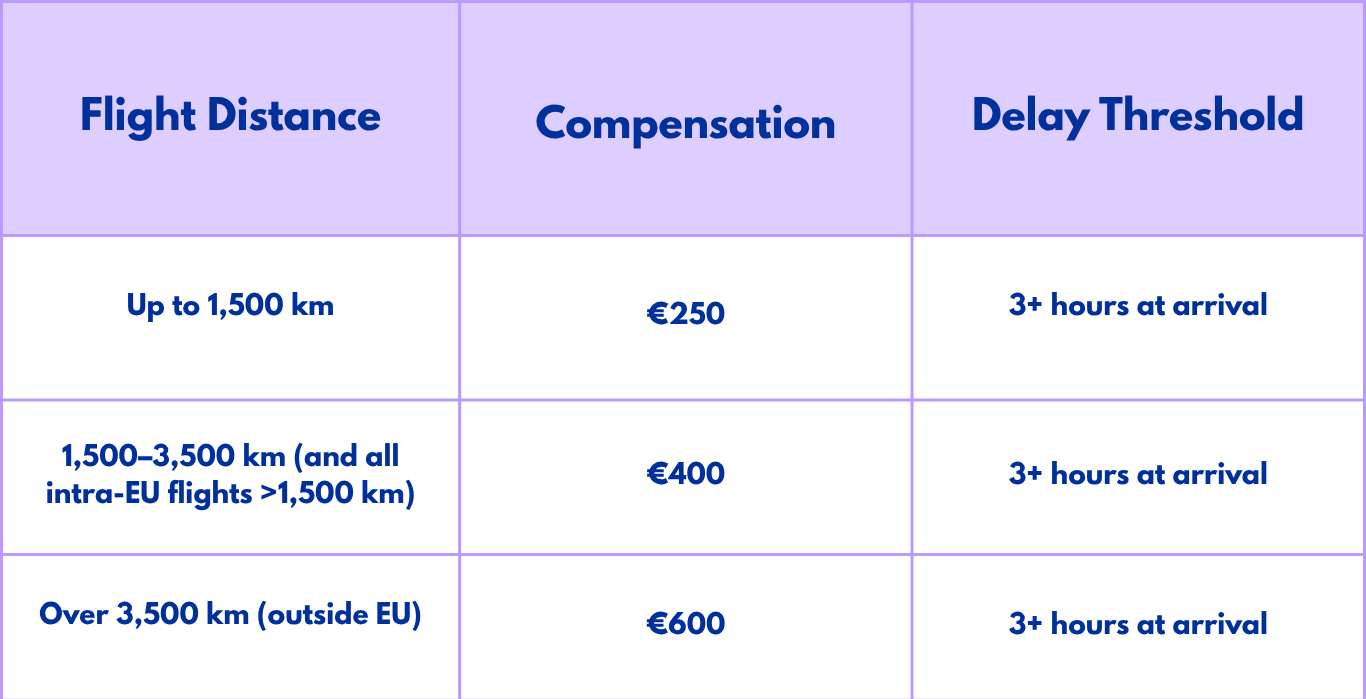
The payouts remain intact: The compensation tiers remain exactly as they were: €250, €400, and €600.
The core structure holds: While the reform brings some modernizations (like clearer rules on intermediary booking agencies and digital claims processes), the fundamental rights to care, rebooking, and cash compensation remain as strong as ever.
Note: The June 2026 provisional agreement is currently undergoing final legal translation and formal adoption, but the existing, powerful rules remain fully in force today.
Precise Impact on Society:
You are entitled to cash compensation, not vouchers or miles. Airlines may offer vouchers, but you are not required to accept them. To pay in vouchers, the airline must legally get your signed agreement. Because of this, airlines frequently offer a higher voucher value (e.g., a €500 voucher instead of €400 cash) as an incentive to get you to agree, though the law does not legally mandate that a voucher be of higher value.
Every passenger with a confirmed seat is entitled to compensation, including infants — though some airlines dispute this for lap infants.
If your flight is part of a package tour, you can claim compensation from the airline AND potentially seek redress from the tour operator.
You have up to 6 years to claim in some countries (UK), but as little as 1 year in others (e.g., some EU Member States). Check your national law.
How to claim: Submit a written claim to the airline with your booking reference, flight details, and the legal basis (Regulation EC 261/2004). If the airline refuses, escalate to your national enforcement body (each EU country has one) or use an alternative dispute resolution service.
Tamari is the founder and author of Behind the Policy. She holds a Bachelor’s degree in Political Science and is completing a Master’s degree in International Politics at KU Leuven. Her work focuses on translating EU laws, regulations, and policy developments into clear explanations of their impact on citizens and society.
Sources et crédits
- 1. Regulation (EC) No 261/2004 of the European Parliament and of the Council of 11 February 2004 establishing common rules on compensation and assistance to passengers in the event of denied boarding and of cancellation or long delay of flights
- https://eur-lex.europa.eu/eli/reg/2004/261/oj/eng
- 2. European Commission — Interpretative Guidelines on Regulation (EC) No 261/2004 (September 2024)
- https://eur-lex.europa.eu/legal-content/EN/TXT/PDF/?uri=OJ:C_202405687
- 3. European Commission — National Enforcement Bodies for Regulation (EC) No 261/2004
- https://transport.ec.europa.eu/document/download/d7b5dd33-4083-4faa-8132-b6dc8b3a1c07_en
- 4. European Commission — Air passenger rights
- https://transport.ec.europa.eu/transport-themes/passenger-rights/air_en
- 5. ECCNet — Flight Delay — European Consumer Centres Network guide to passenger rights
- https://www.eccnet.eu/consumer-rights/what-are-my-consumer-rights/travel-and-passenger-rights/air-passenger-rights/flight
- Cover Image by Ben Klewais on Unsplash. Edited by Tamari Tabatadze
À lire aussi
Employee Until Proven Otherwise: Inside the EU's Historic New Rules for Gig Workers
Under the new EU Platform Work Directive, millions of gig workers, from delivery riders to freelance coders, will automatically be presumed employees if an app controls their work. Discover how this historic law strips algorithms of their power to fire in the dark, forces tech platforms to prove genuine self-employment, and fundamentally rewrites the rules for digital labour across Europe.
Understanding the EU Pay Transparency Directive: A New Era for Job Seekers and Employers
For decades, "equal pay for equal work" was a principle you could not enforce because the numbers were hidden. On 7 June 2026, that ended. Every Member State was required to enforce four new rules: show the salary before the interview, ban questions about your pay history, give you the data to prove discrimination, and force companies to fix unjustified gaps of 5% or more.
EU Right to Repair Directive Explained (2026): Your New Right to Fix Phones, Appliances & Electronics
The EU Right to Repair Directive gives consumers stronger repair rights, longer warranty protection, and access to affordable repairs even after the warranty expires.