EU Deforestation Law: Why Your Coffee and Chocolate Now Need GPS Proof
Europe is rewriting the rules of global trade. Starting 30 December 2026, everyday items like coffee, chocolate, soy, beef and palm oil must be backed by GPS proof that they did not destroy a forest. Fines start at 4% and penalties include removing products from the shelves or seizing the illegal goods. Here is what the EU Deforestation Regulation means for your shopping cart.
Picture your morning coffee, the chocolate bar you grab for an afternoon boost, or the wooden dining table in your kitchen. Behind almost every one of these everyday items is a massive global supply chain that has destroyed ancient forests in the Amazon, Congo Basin, and Southeast Asia for decades. Promises from big companies to fix the problem on their own did not really work and clever marketing tricks (greenwashing) left all of us in the dark. But the EU is about to completely rewrite the rules of global trade, making sure what you buy every day does not cost the Earth´s remaining forests.
What is the EU Deforestation Regulation?
The EU Deforestation Regulation (EUDR), formally. Regulation (EU) 2023/1115, is the EU´s landmark law designed to minimise the Union´s contribution to global deforestation and forest degradation. Adopted by the European Parliament and the Council on 31 May 2023 and published in the Official Journal, it entered into force on 29 June 2023.
The regulation applies to seven relevant commodities and their derived products listed in Annex I:
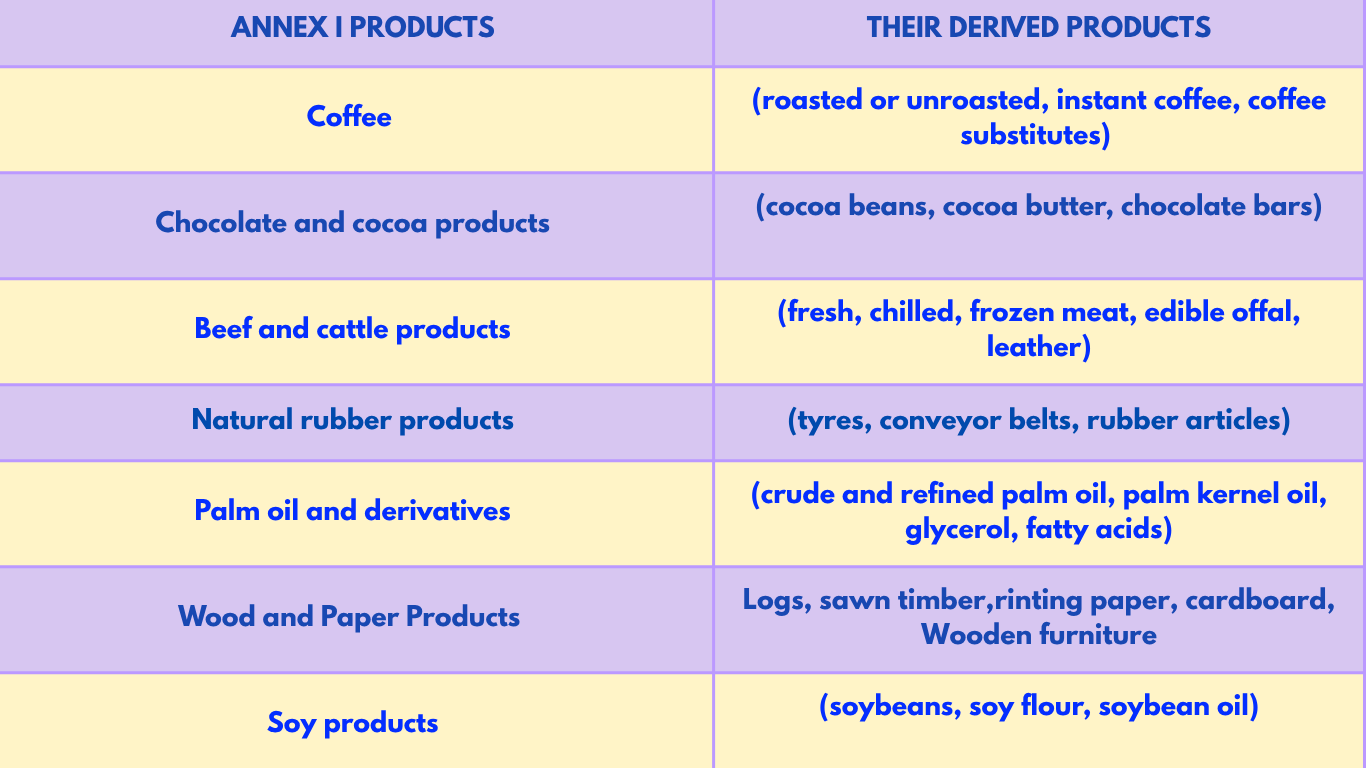
This means that these products must satisfy three cumulative conditions in order to be placed on the EU market or exported:
1. Deforestation Free: The product was not produced on land subject to deforestation or forest degradation after 31 December 2020. Crucially, this covers both illegal and legal deforestation, even if the land was cleared lawfully under local rules, it is still banned if the clearing occurred after the 31 December 2020 cut-off.
2. Legally Produced: The product complies with the relevant legislation of the country of production, including land use rights, environmental protection, labour rights, human rights and anti-corruption laws.
3. Covered by Due Diligence: The operator must submit a Due Diligence Statement (DDS)- A secure digital form that a company must officially submit to the EU before they are legally allowed to sell a product on European shelves. They must submit DDS through the EU´s TRACES information system, declaring that no or only negligible risk of non-compliance was found.
Why It Was Passed:
The EUDR was passed because the EU is one of the world´s largest importers of products linked to deforestation. The European Commission identified that EU consumption was driving forest loss in the Amazon, Congo Basin, and the Southeast Asia which directly contributes to climate change, biodiversity loss and human rights abuses.
For years, companies promised to eliminate deforestation from supply chains through self-regulation, however, deforestation rates continued to rise. Previous rules like the EU Timber Regulation (EUTR) only banned illegally harvested timber. Therefore, the EUDR goes further by banning products from land deforested after 2020, regardless of local legality. And lastly, without geolocation data and digital tracking, it was impossible for consumers, regulators or even companies themselves to verify where commodities actually came from.
As a result, the EUDR uses the EU´s market power, 450 million consumers, as leverage to force global agricultural and forestry supply chains to become transparent and deforestation-free.
What does it mean for citizens ?
Our supermarket staples are now traceable: The coffee in our cup, the chocolate in our bar, the palm oil in our shampoo, the leather in our shoes, and the soy in our tofu must all be traceable to specific plots of land that were not deforested after 2020.
Border blocks: From 30 December 2026, customs will check for the DDS reference number before releasing products for free circulation. This means no statement = No entry. Small and micro businesses follow on 30 June 2027.
While you will not see the DDS on the shelf, this regulation fundamentally changes what products are available at supermarkets. Brands that cannot trace their supply chains will exit the EU market.
No more Greenwashing: Companies can still use sustainability certificates to help check their risks, but a stamp of approval is not enough anymore. They cannot use those certificates to skip heavy paperwork and having a green label does not automatically mean they are following the law.
For Businesses:
- Operators (first importers into the EU) bear the heaviest burden: they must collect geolocation data, conduct risk assessments, submit DDS and keep records for 5 years. However, downstream companies ( like local supermarkets or brands buying ingredients already inside the EU single market) just need to track the reference code, which drastically lowers their administrative burden.
-Under the specific rules of the EUDR, any small or micro enterprise that deals with timber, paper, or wood-based products that were already regulated under the older EU Timber Regulation (EUTR) does not get the extended June 2027 grace period. Instead, wood-related small businesses must comply by 30 December 2026 the exact same deadline as large and medium companies.
What are the Penalties?
Companies face fines worth at least 4% of their total annual sales inside the EU. Additional fines include authorities removing illegal products from the shelves, forcing a total recall, seizing the illegal goods or taking away any money the company made selling these items.
Tamari is the founder and author of Behind the Policy. She holds a Bachelor’s degree in Political Science and is completing a Master’s degree in International Politics at KU Leuven. Her work focuses on translating EU laws, regulations, and policy developments into clear explanations of their impact on citizens and society.
წყაროები და კრედიტები
- 1. Regulation (EU) 2023/1115 of the European Parliament and of the Council of 31 May 2023 on the making available on the Union market and the export from the Union of certain commodities and products associated with deforestation and forest degradation
- https://eur-lex.europa.eu/eli/reg/2023/1115/oj/eng
- 2. EUR-Lex Summary: Fighting deforestation and forest degradation
- https://eur-lex.europa.eu/EN/legal-content/summary/fighting-deforestation-and-forest-degradation.html
- 3. European Commission — Access to Markets: Delay until December 2026 and other developments (July 2026)
- https://trade.ec.europa.eu/access-to-markets/en/news/delay-until-december-2026-and-other-developments-implementation-eudr-regulation
- Cover Image by Tamari Tabatadze
დაკავშირებული სტატიები
EU Nature Restoration Law Explained : What it Means for Your City, Rivers, Bees and Food
81% of Europe ´ s natural habitats are in poor condition. The EU passed a law to fix that. Discover how the Nature Restoration Law protects city trees, brings back pollinators and frees 25,000 km of rivers.
EU Packaging and Packaging Waste Regulation (PPWR) Explained: PFAS Bans, Plastic Wrap Bans, and the 2030 Supermarket Makeover
The EU's Packaging and Packaging Waste Regulation (PPWR) marks the biggest overhaul of packaging rules in 30 years. From banning PFAS "forever chemicals" in food containers to phasing out single-use plastics and overpackaging, this new regulation will fundamentally change how products are packaged, sold, and recycled across all 27 Member States