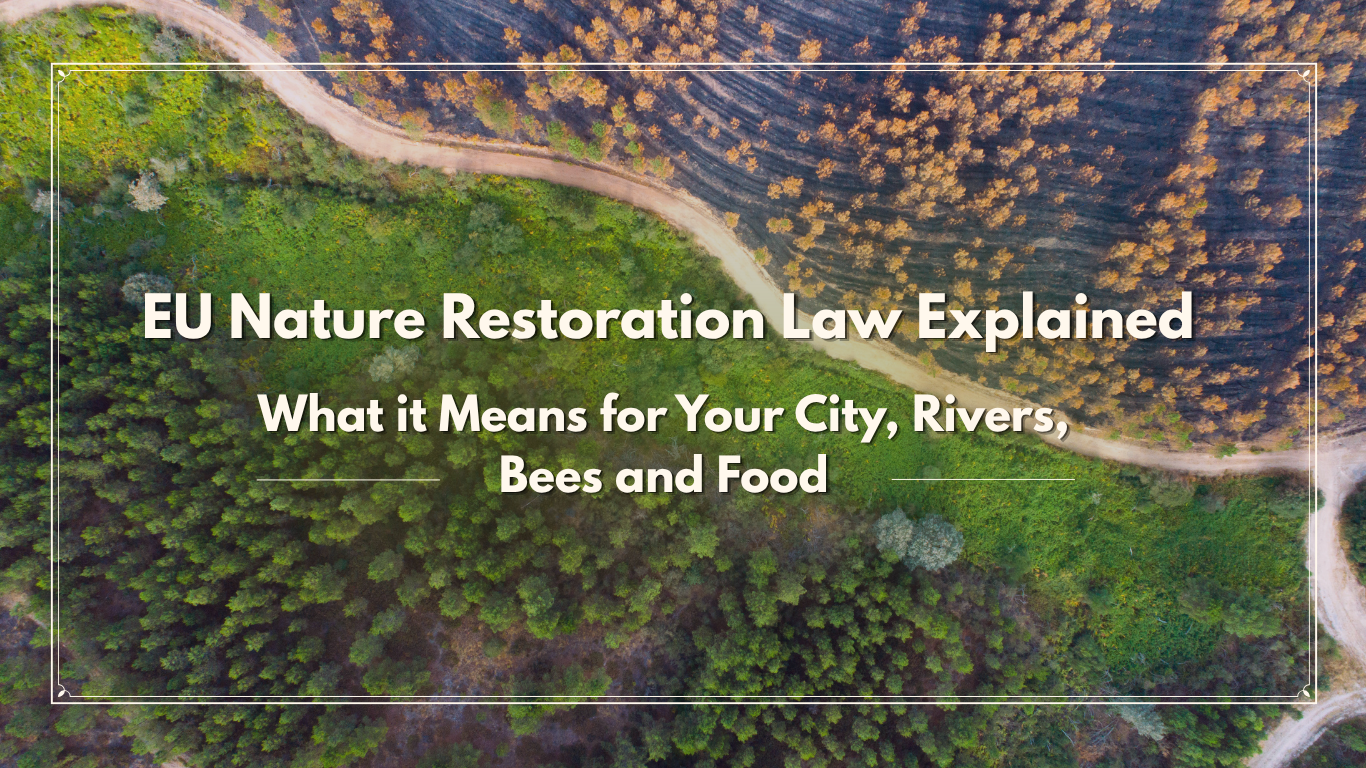
EU Nature Restoration Law Explained : What it Means for Your City, Rivers, Bees and Food
81% of Europe ´ s natural habitats are in poor condition. The EU passed a law to fix that. Discover how the Nature Restoration Law protects city trees, brings back pollinators and frees 25,000 km of rivers.
Have you ever noticed your favorite neighborhood park feeling a little smaller, or spent a summer afternoon wondering where all the bees went? It is not just your imagination; Europe has quietly been losing its green heart bit by bit. Every single year, Europe loses an area of healthy soil roughly the size of Budapest to urban spread and concrete expansion. We have reached a critical tipping point where over 80% of EU natural habitats are officially classified as degraded or in poor condition. Up until now, European environmental laws were designed to keep things from getting worse, acting as a shield for existing nature reserves. But when 4/5 of your natural foundation is already broken, simply preserving the nature is no longer enough. The EU Nature Restoration Law was born out of this exact crisis, it is a legally binding blueprint requiring every Member State to revive degraded ecosystems, protect urban tree canopy and bring life back to our landscapes. It demands that governments repair damaged land, free blocked rivers, and green our cities by law. Here is why this law exists and what it actually means for your daily life.
The Law Explained:
The Nature Restoration Law is the EU ´ s most ambitious environmental legislation to date. The Regulation establishes a legally binding framework for the long-term recovery of biodiverse and resilient ecosystems across all EU Member States ´ land and sea areas. It operates on three interconnected areas: Overarching EU targets- meaning at least 20% of the EU´s land and sea areas must be under restoration measures by 2030 and all ecosystems in need of restoration must be covered by 2050; Habitat-specific restoration obligations which are quantified, time-bound targets for terrestrial, coastal, freshwater, and marine ecosystems listed in Annexes I and II; And lastly, Ecosystem-specific obligations that are targeted measures for urban areas, rivers, pollinators, agricultural land, forests and marine habitats.
Critically, this is the first EU environmental law to move beyond conservation (protecting what remains) to active restoration (recovering what has been lost). It amends Regulation (EU) 2022/869 and works alongside the Habitats Directive (92/43/EEC) and Birds Directive (2009/147/EC), but adds binding deadlines that those directives lacked.
Why It Was Passed:
The Nature Restoration Law was passed in response to a documented ecological crisis. The European Environment Agency ´ s 2020 State of Nature report confirmed that 81% of EU habitats are in poor condition and biodiversity continues to decline despite decades of conservation efforts. One in three bee and butterfly species is in decline, Europe loses approximately 540 km2 of soil annually to land take. The European Commission identified five structural failures:
1. Conservation without recovery: Previous laws like the Habitats Directive protected existing nature but set no deadlines for restoring degraded ecosystems. As we saw, protection alone was insufficient to reverse decline
2. No binding urban nature targets: Cities were growing faster and denser, on the other hand, greener spaces were shrinking without any EU-level obligation to maintain or expand them
3. Pollinator collapse threatening food security: The decline of bees, butterflies and other pollinators was increasing which had direct consequences for agricultural productivity and ecosystem resilience.
4. Fragmented rivers and lost floodplains: Dams, weirs, and barriers had severed river connectivity across Europe, destroying fish migration routes and natural flood management systems.
5. Climate and biodiversity crises intertwined: Degraded ecosystems absorb less carbon, provide less protection against extreme weather, and offer fewer benefits to human health and well-being.
The law therefore aims to contribute to the EU´s climate change mitigation and adaptation objectives, land degradation neutrality, food security and international biodiversity commitments under the Convention on Biological Diversity.
What this Law Means for Everyday Life
Greener Cities & Neighborhoods
By 2030, EU countries cannot let the total amount of city parks, gardens and street trees shrink compared to 2024. After 2030, cities must actively get greener over time. For example, if one city in the EU country turns a vacant green lot or a small local park into an apartment complex, second city in the EU country has to balance it out by planting trees or creating a new green space elsewhere. (Cities that are extremely green with over 45% green space and 10% tree shade, are exempt from the 2030 rule since they are already ahead of the curve).
Bringing Back Bees and Butterflies
Governments must stop the drop in bee, butterfly and hoverfly populations by 2030 and then ensure that their number keeps growing. You’ll see fewer sterile grass lawns and more wildflower patches along roadsides, in public parks, and on farmland. For you, this means healthier food crops like apples, berries, and tomatoes, which depend directly on these insects to grow.
Freeing Our Rivers
The goal is to open up 25,000 km of blocked rivers by 2030. Countries must look at man-made obstacles in rivers and remove old, useless structures so water can flow naturally again. Tearing down abandoned small dams or broken weirs allows migratory fish (like salmon) to swim upstream to spawn. Free-flowing rivers also act as natural sponges, absorbing overflow during heavy rain to protect nearby towns from flash floods and giving people clean spots for kayaking and swimming.
Healthier, Wild Forests
Instead of dark, single-species tree farms planted in rigid rows, forests must become diverse, living habitats that store carbon and resist wildfires. Forestry teams will leave dead tree trunks on the forest floor rather than clearing them away. This deadwood provides food and shelter for beetles, mushrooms, and woodpeckers. Forests will also feature trees of different ages and species, making them stronger against droughts and pests.
Restoring the Oceans
EU countries must clean up and rebuild marine habitats like underwater seagrass meadows and seafloors. Restoring seagrass beds creates nursery habitats for young fish, boosts sea life (benefiting dolphins, sea turtles and seabirds) and cleans coastal waters.
At its core, the Nature Restoration Law gives Europe a step-by-step plan to fix damaged nature, starting with 30% of degraded habitats by 2030 and reaching 90% by 2050. For people in towns and cities, it marks a huge win by treating local parks and urban trees as essential parts of a healthy neighborhood. The clock is already ticking and every EU country must submit its official restoration plan to the European Commission by 1 September 2026. Official environmental agencies will track promises and if a country lags behind or breaks the rules, the European Commission can take legal action to enforce compliance. Ultimately, this law turns vague environmental pledges into real, binding action which gives us, everyday citizens, greener and healthier Europe.
Tamari is the founder and author of Behind the Policy. She holds a Bachelor’s degree in Political Science and is completing a Master’s degree in International Politics at KU Leuven. Her work focuses on translating EU laws, regulations, and policy developments into clear explanations of their impact on citizens and society.
წყაროები და კრედიტები
- 1. Regulation (EU) 2024/1991 of the European Parliament and of the Council of 24 June 2024 on nature restoration and amending Regulation (EU) 2022/869
- https://eur-lex.europa.eu/eli/reg/2024/1991/oj/eng
- 2. European Commission — Nature Restoration Regulation
- https://environment.ec.europa.eu/topics/nature-and-biodiversity/nature-restoration-regulation_en
- 3. European Commission — Commission adopts user-friendly planning tool to support Member States (20 May 2025)
- https://environment.ec.europa.eu/news/commission-adopts-user-friendly-planning-tool-support-member-states-implementing-nature-restoration-2025-05-20_en
- 4. European Environment Agency — State of Nature in the EU (2020)
- https://www.eea.europa.eu/en/analysis/publications/state-of-nature-in-the-eu-2020
- 5. Nature (Scientific Journal) — Assessing the implications of EU Nature Restoration Law targets (May 2025)
- https://www.nature.com/articles/s42949-025-00213-z
- 6. European Law Blog — National implementation of the Nature Restoration Law (July 2025)
- https://europeanlawblog.eu/jghlh4z8/
- 7. European Law Blog — National implementation of the Nature Restoration Law (July 2025)
- https://eurocities.eu/resources/urban-ecosystem-restoration-baselines-and-data/
- Cover Image by Tamari Tabatadze
დაკავშირებული სტატიები
EU Deforestation Law: Why Your Coffee and Chocolate Now Need GPS Proof
Europe is rewriting the rules of global trade. Starting 30 December 2026, everyday items like coffee, chocolate, soy, beef and palm oil must be backed by GPS proof that they did not destroy a forest. Fines start at 4% and penalties include removing products from the shelves or seizing the illegal goods. Here is what the EU Deforestation Regulation means for your shopping cart.
EU Packaging and Packaging Waste Regulation (PPWR) Explained: PFAS Bans, Plastic Wrap Bans, and the 2030 Supermarket Makeover
The EU's Packaging and Packaging Waste Regulation (PPWR) marks the biggest overhaul of packaging rules in 30 years. From banning PFAS "forever chemicals" in food containers to phasing out single-use plastics and overpackaging, this new regulation will fundamentally change how products are packaged, sold, and recycled across all 27 Member States