THE EU'S FOUR POWER CENTERS: What the European Council, Parliament, Council of the EU, and Commission Actually Do
Ever wonder who actually makes the rules in the EU? When you hear "the EU decided," it can feel like strangers in a faraway city are just handing down orders. But Brussels isn't a mystery, it’s a system built on four main groups. Here is a simple breakdown of who comes up with the ideas, who writes the laws, and how your vote shapes the rules that affect your daily life.
When your two-year-old washing machine suddenly breaks, you invoke your legal right to have it repaired instead of being forced to spend more money and buy a new one. Or during your weekend trip, across the EU, you stream a podcast on cellular data without a second thought about extra roaming fees.
These daily conveniences did not appear out of thin air or corporate goodwill. These laws were fiercely debated, drafted and signed into law in Brussels. Yet, when headlines say ¨The EU decided ¨, it often paints a picture of some distant, faceless group forcing rules on the rest of us. The truth is, the EU is very structured, highly political, and driven by your vote. The EU is not one big government, it is made up of four different groups that keep each other in check. Any rule that impacts your life has to get approved by all four of these groups. Brussels is not some big mystery, once you know who comes up with the ideas, who writes them and who votes on them, the whole system of the European Union actually makes sense.
1. THE EUROPEAN COUNCIL- THE STRATEGIC LEADERS
The European Council brings together EU leaders to set the bloc´s political agenda. It represents the highest level of political cooperation between EU countries.
What it does:
Sets the Agenda: it defines the EU´s overall political direction and priorities (for example, setting the goal to become climate-neutral by 2050)
Crisis Management: It handles complex or sensitive issues that cannot be solved at the lower levels of intergovernmental cooperation
High-Level Appointments: It nominates the President of the European Commission, elects the President of the European Council, and officially appoints the High Representative for Foreign Affairs
Important note: The European Council DOES NOT negotiate or adopt EU laws.
How it works: It is made up of Heads of State or Government of all 27 EU Member States, the European Council President ( currently António Costa) and the European Commission President. It meets at least twice a year in Brussels for ¨ EU Summits ¨.
Why it matters to you: When major geopolitical crises hit or sweeping new policy goals are announced, it starts here. Your Prime Minister or President represents your country´s overarching interests at this table.
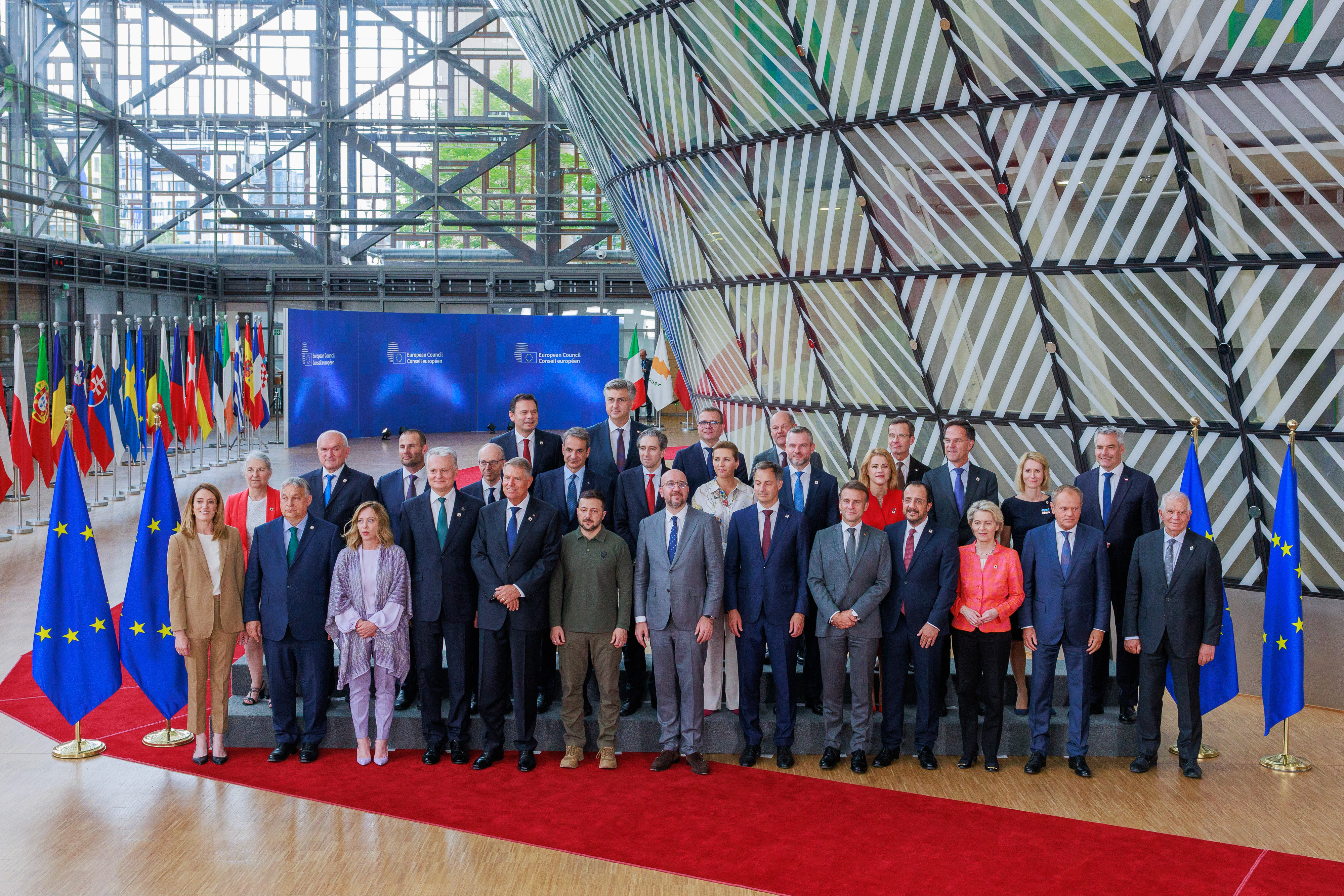
© EU//Cristophe Licoppe
2. THE EUROPEAN PARLIAMENT- THE CITIZENS´ VOICE
The European Parliament is the EU´s directly elected legislative assembly. It is the voice of the citizens. It is directly elected by the people of the EU, to keep things fair between large and small countries, there is a rule: no country can have fewer than 6 Members of the Parliament (MEPs) or more than 976. For the 2024-2029 term, it comprises 720 Members of the European Parliament (MEPs)
What it does:
Co-Legislator: Together with the Council of the EU, Parliament negotiates, amends and adopts EU laws. Neither body can pass a law alone.
Budgetary power: Parliament approves the EU´s annual budget and inspects how it is spent.
Executive oversight: Parliament elects the Commission President and must approve the entire College of Commissioners. It can force the Commission to resign via a motion of censure.
How it works: MEPs sit in transnational political groups ( For example, European People´s Party, Socialists & Democrats, Renew Europe, Greens) not by country.
Why it matters to you: This is the only institution you vote for directly. Your MEP amends laws that affect your digital rights, consumer protection, workplace etc.

© European Union 2024 - Source : EP
3. THE COUNCIL OF THE EUROPEAN UNION- THE MEMBER STATES´ VOICE
The Council of the EU (often just called ¨the Council¨ or ¨the Council of Ministers¨) is where the 27 national governments meet to negotiate and adopt EU legislation. It should not be confused with the European Council.
What it does:
Co-legislator: Alongside Parliament, the Council negotiates and adopts EU laws based on Commission proposals
Policy coordination: Ministers coordinate national policies in areas like economy policy and defense.
Concluding international agreements: The Council authorises the Commission to negotiate trade deals and then approves them.
How it works: The Council meets in 10 different configurations depending on the topic (For example, ECOFIN for finance ministers, AGRIFISH for agriculture ministers). Most decisions are taken by qualified majority (requiring 55% of countries representing 65% of the EU population). Sensitive areas require unanimity. The Presidency of the Council rotates every 6 months between Member States.
Why it matters to you: If your national government opposes the AI or pushes for stricter climate targets, this is where that battle happens.
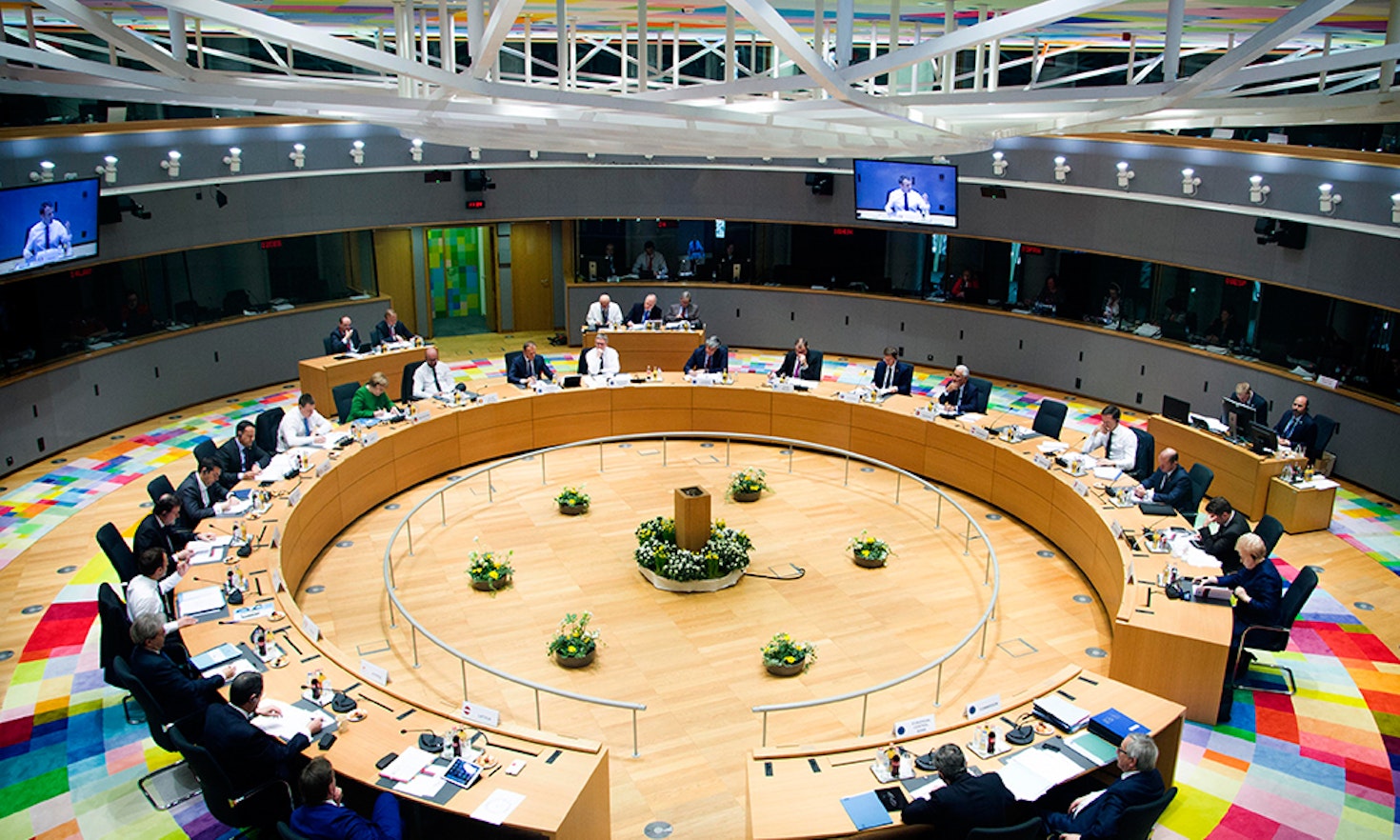
European Council, 28 and 29 June 2018. European Parliament/Multimedia Centre
4. THE EUROPEAN COMMISSION- INTERESTS OF ENTIRE EU
Unlike the Council, which fights for national interests, the European Commission's job is to protect the interests of the entire EU as a whole. The European Commission is led by a College of 27 Commissioners, one from each Member State, but they are not supposed to take orders from their home capitals.
What it does:
Right of Initiative: Only the Commission can formally propose new EU laws
Guardian of the Treaties: The Commission monitors whether Member States correctly implement EU law and can take them to court if they do not.
Budget manager: The Commission manages the EU budget and allocated funds
External representative: The Commission negotiates trade agreements on behalf of all 27 Member States.
How it works:
-The College of Commissioners decides on political strategy collectively. Each Commissioner holds a specific portfolio (e.g., Trade, Environment, Digital).
-The Commission President ( Currently Ursula von der Leyen) is nominated by the European Council and elected by the European Parliament.
- The Commission employs around 32,000 staff to draft technical legislation and implement policies.
Why it matters to you: The Commission sets the legislative agenda. If it does not propose a law, Parliament and the Council of the EU cannot pass one. It also enforces the rules, ensuring tech giants and national governments comply with EU standards.

© European Commission
This separation of powers ensures that no single institution dominates, and that citizens (via Parliament), national governments (via the Council of the EU), and broader strategic interests (via the European Council and Commission) are all balanced.
Tamari is the founder and author of Behind the Policy. She holds a Bachelor’s degree in Political Science and is completing a Master’s degree in International Politics at KU Leuven. Her work focuses on translating EU laws, regulations, and policy developments into clear explanations of their impact on citizens and society.
Bronnen & credits
- 1.European Parliament — 2024-2029 European Parliament: how many MEPs per country
- https://www.europarl.europa.eu/topics/en/article/20180126STO94114/2024-2029-european-parliament-how-many-meps-per-country
- 2. European Commission — Von der Leyen Commission 2024-2029
- https://commission.europa.eu/about/commission-2024-2029_en
- 3. European Commission — College of Commissioners
- https://commission.europa.eu/about/organisation/college-commissioners_en
- 4. Council of the European Union — What the Council does
- https://www.consilium.europa.eu/en/council-eu/what-the-council-does/
- 5. European Commission — Organisation
- https://commission.europa.eu/about/organisation_en
- Cover Image by Tamari Tabatadze
Verwante artikelen
HOW AN EU LAW IS ACTUALLY MADE (AND HOW YOU CAN FORCE BRUSSELS TO WRITE ONE)
Brussels is not a black box—it is a highly structured, democratic machine. Learn exactly how the Ordinary Legislative Procedure turns ideas into laws, what really happens in closed-door trilogues, and discover how 1 million regular citizens can use the European Citizens' Initiative to write the rules themselves.
New Euro Banknotes 2026: How to Vote on the Redesign, the Two Themes, and What Changes for Your Wallet
A complete guide to the upcoming euro banknote redesign. Learn about the proposed themes, how to participate in the public vote, and what the new security, accessibility, and environmental upgrades mean for your everyday cash.