Employee Until Proven Otherwise: Inside the EU's Historic New Rules for Gig Workers
Under the new EU Platform Work Directive, millions of gig workers, from delivery riders to freelance coders, will automatically be presumed employees if an app controls their work. Discover how this historic law strips algorithms of their power to fire in the dark, forces tech platforms to prove genuine self-employment, and fundamentally rewrites the rules for digital labour across Europe.
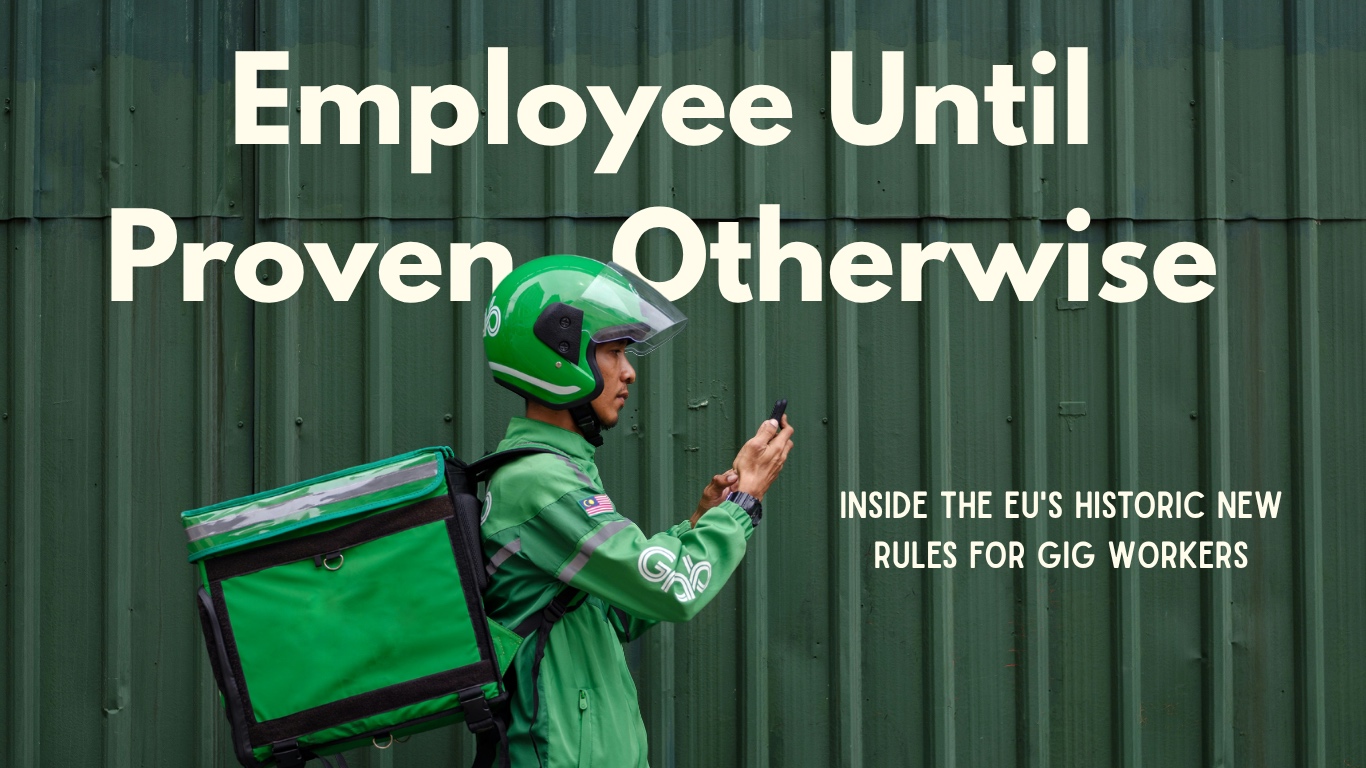
Ever had a boss you could not argue with? Now imagine your boss is not even a person, it is a line of code.
If you have ever delivered food, driven for a rideshare app, or picked up freelance coding gigs on a digital platform, then you already know how the game is played. The app tells you what to do, controls how much you earn, and tracks your performance down to the second. But the moment you ask for minimum wage, holiday pay or an explanation for why your account was suddenly suspended, the platform throws its hands up and says ¨You do not work for us. You are your own boss!¨.
It was a loophole that left 28 million platform workers across the EU without basic safety nets and built billion dollar empires on the backs of gig workers that had zero job security and algorithms for managers. Now, the EU has officially decided that if an app acts like your employer, it has to treat you like an employee and algorithms are no longer allowed to fire you in the dark.
The Law Explained:
The EU Platform Work Directive, formally Directive (EU) 2024/2831, is the EU´s most significant labour reform for the gig economy. Adopted by the Council on 14 October 2024, signed on 23 October 2024, and published in the Official Journal (OJ L, 11.11.2024), it entered into force on 1 December 2024. Member States must transpose it into national law by 2 December 2026.
What is a Digital Labour Platform?
The directive applies to digital labour platforms- defined as any natural or legal person providing a commercial service that :
- Is provided at least in part remotely through electronic means; Is provided at the request of a recipient; Organises work performed by individuals as a necessary component; Uses automated monitoring or automated decision-making systems.
The European Commission generally divides these protected workers into two main categories: location-based workers and online web-based workers.
Location Based Workers
○ Ride-Sharing drivers: Drivers for apps like Uber, Bolt or FreeNow who are assigned routes, monitored for speed/routes, and face algorithm-driven passenger ratings○ Food and grocery couriers: Riders for Deliveroo, UberEats, Gorillas, or Lieferaando. Under the new rules, if an app penalizes a rider for refusing a delivery or dictates a specific delivery window, the rider is presumed to be an employee.
○ On-demand trades and micro tasks: Plumbers, handymen, or beauty professionals (like at home massage therapists or nail technicians) who are dispatched via centralized service apps
Online Web-based Workers
○ Software coders and programmers: Tech workers who take on freelance engineering tickets through platforms like Upwork or Toptal○ Translators and transcribers: Freelancers translating documents or typing up audio files for platforms that use algorithms to automatically assign tasks based on speed or past ratings
○ Graphic designers and copywriters: creative professionals bidding for jobs on centralized marketplaces.
This directive Rests on 4 Pillars
Pillar 1: You are an Employee Until Proven Otherwise
If an app acts like your boss ( limits how much you can charge or earn; tracks your performance; dictates when you have to be online or penalizes you for logging off), the law will now treat it like your boss. If a platform controls how you do your job, the law automatically assumes you are an ¨employee¨ which means you get rights like minimum wage, sick leave and holiday pay. If the company claims you are just an independent freelancer, it is now their job to prove it. The burden is no longer on the worker to fight for their status.
Pillar 2: Algorithmic Management Transparency
Platforms must inform workers about automated monitoring and decision-making systems, what data is collected, how decisions are made, and who received the data. Workers must receive concise information on their first working day and whenever systems change. Comprehensive information must be provided to worker representatives and authorities on request.
Pillar 3: Humans Must Review Significant Decisions
Any decision to restrict, suspend or terminate an account; refuse payment; or change contractual status, if taken or supported by an automated system, must be reviewed by a human if the worker requests it. The platform must provide written reasons without a delay and respond to review the requests within 2 weeks. The decision itself must be taken by a human being.
Pillar 4: Data, Enforcement & Collective Rights
Platforms must declare platform work to national authorities; every 6 months, platforms must report: number of workers, employment status, average hours, average income and terms and conditions; Workers gain collective representation rights and protection from retaliation.
Why Was The Law Passed:
The directive was passed because the gig economy exploded across the EU while labour protections lagged decades behind. An estimated 28 million people perform platform work in the EU, many classified as ¨self-employed¨ despite being controlled by algorithms that set their pay, monitored their performance and terminated their accounts.
Platforms systematically classified workers as independent contractors to avoid minimum wage, social security, holiday pay and dismissal protections, even when the platform exercised full control over the work relationship. In addition, workers had no right to know how algorithms allocated tasks set pay, or evaluated performance. Termination could happen instantly by machine, with no explanation or appeal. Self-employed platform workers were often excluded from collective bargaining rights, preventing unionisation and wage-setting.
The directive therefore aims to ensure that platform work is genuinely self-employed when it is free and employment when it is controlled, with transparency and human oversight as the baseline.
Precise Impact on Society:
For Platform Workers:
○ Employment status flip: If your platform controls your tasks, hours, or pay, you are presumed to be an employee and the platform must prove otherwise. This unlocks minimum wage, paid leave, sick pay, social security contributions and unfair dismissal protection.
○ Algorithmic transparency on day one: On your first working day, you must receive concise information about the automated systems that will monitor you, evaluate you and decide your pay and task allocation.
○ Right to explanation and review: If an algorithm restricts, suspends, or terminates your account, or refuses your payment, you can request human review. You must get written reasons and a response within 2 weeks.
○ Data portability: You can take your ratings, reviews, and work history data with you when you switch platforms.
For Consumers:
○ Gig services may become more expensive as platforms absorb employment costs (social security, minimum wage, benefits)
○ Some platforms may exit markets where compliance costs outweigh profits.
○ Service quality may improve with more stable, protected workforces.
Tamari is the founder and author of Behind the Policy. She holds a Bachelor’s degree in Political Science and is completing a Master’s degree in International Politics at KU Leuven. Her work focuses on translating EU laws, regulations, and policy developments into clear explanations of their impact on citizens and society.
Bronnen & credits
- 1. Directive (EU) 2024/2831 of the European Parliament and of the Council of 23 October 2024 on improving working conditions in platform work
- https://eur-lex.europa.eu/eli/dir/2024/2831/oj/eng
- 2. EUR-Lex Summary: Improving working conditions in platform work
- https://eur-lex.europa.eu/EN/legal-content/summary/working-conditions-in-platform-work.html
- 3. ETUI — The EU Platform Work Directive
- https://www.etui.org/publications/eu-platform-work-directive
- 4. Employsome — EU Platform Work Directive 2026: Rules, Deadline, Impact (May 2026)
- https://employsome.com/blog/platform-work-directive/
- Original Photo by Pim de Boer on Unsplash. Edited by Tamari Tabatadze.
Verwante artikelen
Flight Cancelled? The Secret to Unlocking Your €600 EU Compensation
Airlines are quick to offer a cheap meal voucher when your flight is delayed, but under EU law, they likely owe you up to €600 in cash. Discover how EU Regulation 261 works, what the 2026 reform means for you, and exactly how to claim your money.
Understanding the EU Pay Transparency Directive: A New Era for Job Seekers and Employers
For decades, "equal pay for equal work" was a principle you could not enforce because the numbers were hidden. On 7 June 2026, that ended. Every Member State was required to enforce four new rules: show the salary before the interview, ban questions about your pay history, give you the data to prove discrimination, and force companies to fix unjustified gaps of 5% or more.
EU Right to Repair Directive Explained (2026): Your New Right to Fix Phones, Appliances & Electronics
The EU Right to Repair Directive gives consumers stronger repair rights, longer warranty protection, and access to affordable repairs even after the warranty expires.